Student Loan Forgiveness for Pastors and Clergy: What Most People in Ministry Don’t Know

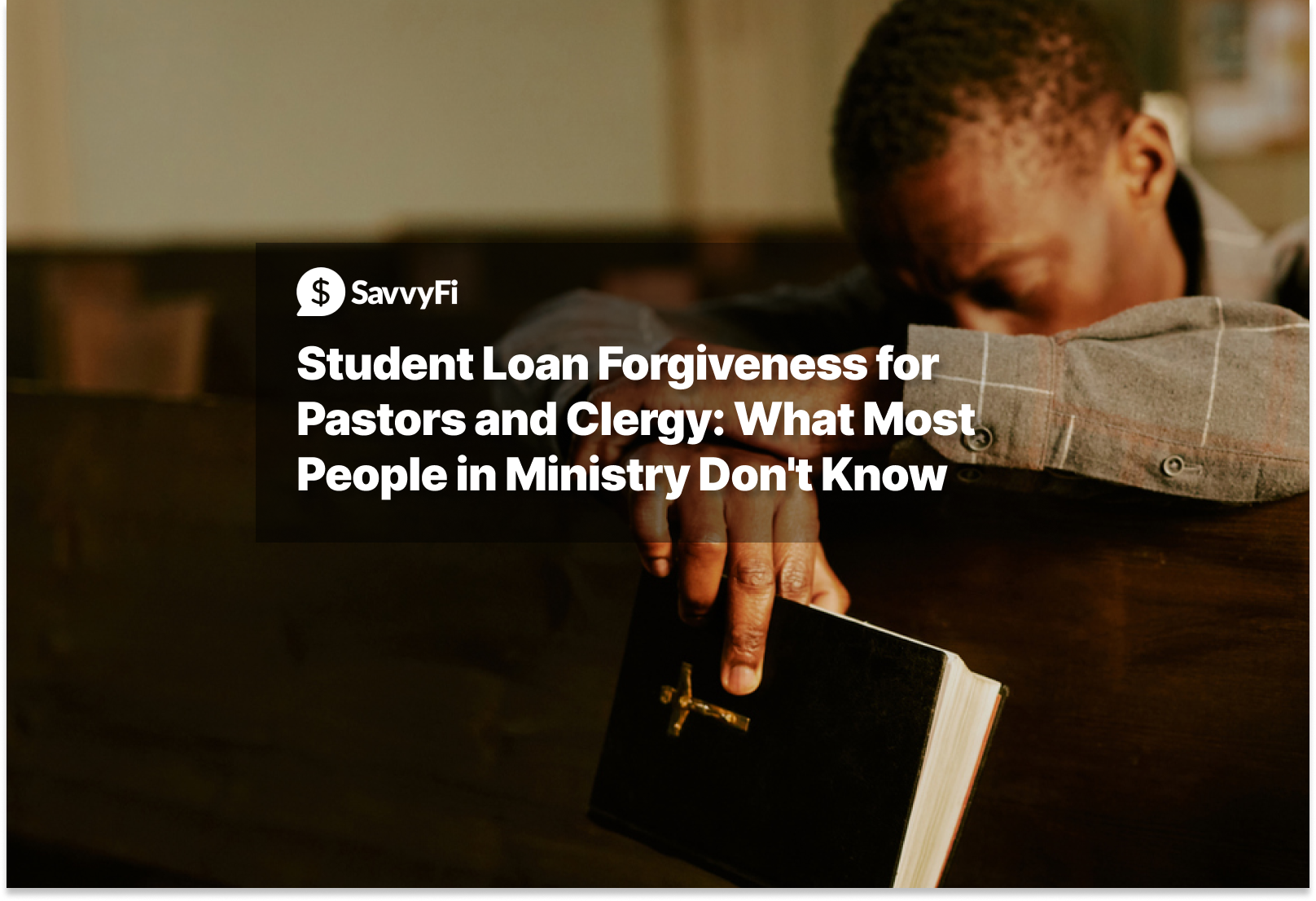
Student Loan Forgiveness for Pastors and Clergy: What Most People in Ministry Don't Know

Seminary costs money. A lot of it.

Many pastors, chaplains, and other ministry workers enter service with six figures of student debt and salaries that don’t leave much room to pay it down. And while they’re focused on caring for their communities, their loans sit in the background, quietly growing.

What most of them don’t know is that they may already qualify for a program that could forgive a significant portion of that debt. Some may be closer to forgiveness than they think.

That program is Public Service Loan Forgiveness, or PSLF.

What is PSLF, and why does it matter for clergy?

Public Service Loan Forgiveness is a federal program that forgives the remaining balance on your federal student loans after you’ve made 120 qualifying monthly payments while working full-time for a qualifying employer.

Churches, synagogues, mosques, and other religious organizations are typically considered tax-exempt under Section 501(c)(3) of the tax code. That means they almost always qualify as eligible employers under PSLF.

If you’re a pastor, associate pastor, youth minister, chaplain, or other ministry worker employed by a qualifying religious organization, your years of service may already be counting toward forgiveness.

The catch: most people in ministry never find out because the system is confusing, the paperwork is overwhelming, and no one walks them through it.


What happens in a real coaching session

We recently worked with a pastor who had been trying to navigate PSLF on her own for years. She had loans spread across multiple servicers, some of which had gone into default. She’d submitted PSLF paperwork before but had no tracker showing progress. She couldn’t tell if anything she’d done had counted.

She came into the call frustrated and exhausted. She left with hope.

Here’s what her SavvyFi loan coach did in a single session:

Confirmed employer eligibility. She had worked for three different churches over her career. Her coach looked up each one using their federal EIN numbers and confirmed all three qualify for PSLF.

Identified existing credit. Based on her loan history, her coach believed a meaningful portion of her balance already has credit built toward the 120-payment threshold. That means she may not be starting from zero.

Mapped out a payment plan. Using the federal Loan Simulator, her coach identified Income-Based Repayment as the right plan for her situation. Her projected payment: approximately $120 per month, far less than she had feared.

Started the certification process on the spot. Together, they logged into studentaid.gov and began submitting employer certification forms for each of her churches during the call itself.

Created a clear next steps list. Consolidation, forbearance while waiting for the consolidation to process, income documentation, and follow-up calls were all mapped out so nothing fell through the cracks.

What felt like an endless circle for years started to feel manageable in under an hour.

Why PSLF is so hard to navigate alone

The student loan system was not designed for ease. Loans change servicers. Portals have different interfaces. Forms expire. Two-factor authentication locks you out at the worst moment.

Even people who are doing everything right often have gaps in their PSLF progress because a form wasn’t submitted correctly, an employer wasn’t certified, or they were on the wrong repayment plan without knowing it.

Some of the most common problems we see with clergy and ministry workers:

Wrong repayment plan. Not all income-driven plans qualify for PSLF. If you’re on a standard plan or certain extended plans, your payments may not be counting toward forgiveness even if you’re making them on time.

Missing employer certifications. You need to certify each employer separately, including past employers. If you’ve served multiple churches, each one needs its own form.

Loans in the wrong category. Older FFEL loans do not qualify for PSLF on their own. They need to be consolidated into a Direct Consolidation Loan first. Many people don’t know this, and years of payments on FFEL loans don’t count.

No progress tracker. Without an active PSLF tracker showing on your studentaid.gov dashboard, you may not know if your payments are being counted. Getting that tracker up and running is one of the first things a coach will help you do.


What qualifying for PSLF actually looks like

To qualify for PSLF, you need to meet four conditions:

  1. Have federal Direct Loans (or consolidate your loans into a Direct Consolidation Loan)
  2. Be enrolled in a qualifying income-driven repayment plan
  3. Work full-time for a qualifying employer (most churches and religious nonprofits qualify)
  4. Make 120 qualifying monthly payments

You do not need to make those 120 payments consecutively. If you’ve been in and out of ministry or moved between qualifying employers over the years, those payments can still count.

And if your income is low enough relative to your family size, your monthly payment may be very low, or even $0, and those months still count toward your 120.

A note on full-time status

One question that comes up often for clergy is what counts as full-time. Many pastors serve part-time at one church, or split time between two congregations.

Under PSLF rules, you are considered full-time if you work at least 30 hours per week. If you’re serving two part-time positions at two qualifying employers, those hours can be combined to meet the threshold.

This is something a coach can help you document correctly so none of your time is left on the table.


How denominational organizations can help

If you lead a denomination, regional body, or benefits organization for clergy, student loan debt is likely affecting more of your people than you know.

Most pastors are not talking about their loan burden. They’re carrying it quietly, often for years, while trying to serve their communities.

Programs like PSLF exist to help them. But without guidance, most people in ministry never access the relief they’ve already earned.

Connecting your clergy with student loan coaching is one of the most meaningful financial wellness benefits you can offer. And for many of them, the impact is immediate.


Where to start

If you work in ministry and carry student loan debt, the first step is finding out where you stand.

That means knowing what types of loans you have, which repayment plan you’re on, whether your employer qualifies, and how many payments may already count toward forgiveness.

A free screening call with a SavvyFi loan coach takes 5 to 10 minutes and gives you a clear picture of your situation with no obligation.

You’ve spent years serving others. Let someone help you figure out what you’re owed.

Book your free screening call.


About SavvyFi: SavvyFi is a user-friendly fintech platform that makes it easy for employers to provide college savings and student loan benefits to their employees. Because the company’s platform is “zero-touch” to HR — without any complicated systems, integrations, or paperwork — SavvyFi unlocks education financing capabilities to even the smallest employers that would not otherwise be able to offer these benefits.

Disclosure: Third-party quotes shown may not be representative of the experience of all SavvyFi customers and do not represent a guarantee of future performance or success.

More articles

Have questions?

Request more information.

Our expert team is on standby to answer any questions you may have about SavvyFi’s platform.