***This article was originally published by our partners, PracticeLink, on July 7, 2026. Read the full post here.***
Most physicians know that Public Service Loan Forgiveness exists.
Far fewer know whether they’re actually on track for it.
That gap — between “I think I’m doing the right things” and “I know exactly where I stand” — is where hundreds of thousands of dollars can quietly slip away.
Beth is a plastic surgeon at an academic medical center. She’d been an attending for three years, completed six years of residency and a year of fellowship, and had been making payments the entire time. When she logged into the PSLF portal to check her progress, it showed one qualifying payment.
One.
She almost walked away from the program entirely.
Instead, she booked a session with SavvyFi. Within an hour, she learned she was actually five months away from having $118,000 in student loans forgiven — and that 114 of her qualifying payments simply hadn’t been certified yet.
If you’re a physician carrying six-figure student debt and working at a nonprofit hospital or academic medical center, this article is for you.
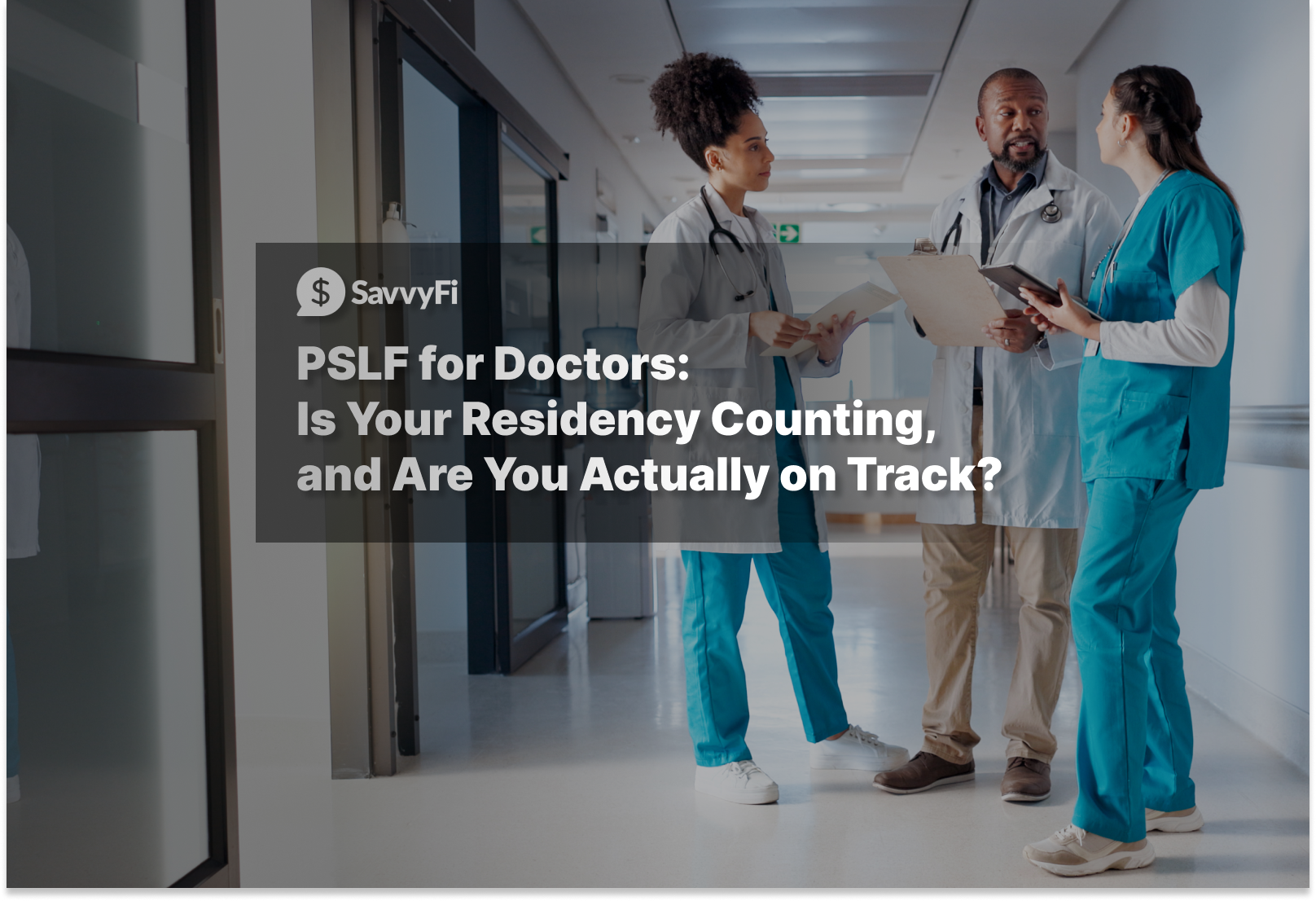
Does residency count toward PSLF for doctors?
Yes, and this is one of the most important things physicians need to understand.
If you completed your residency at a nonprofit hospital or academic medical center, every month you were making qualifying payments on an income-driven repayment plan during that time counts toward your 120 payments.
The same is true for fellowship.
That means a physician who completed a four-year residency and a one-year fellowship before joining an academic center as an attending may already have 60+ qualifying payments banked before their first day as an attending.
Beth’s six-year residency and one-year fellowship were spent at qualifying employers. Combined with three years as an attending, she had nearly 10 years of employment at PSLF-eligible institutions. She just hadn’t certified all of it yet.
How do I check if my hospital qualifies as a PSLF employer?
PSLF requires that you work for a qualifying employer: generally a government agency or a 501(c)(3) nonprofit organization.
Most academic medical centers, university hospitals, and VA hospitals qualify. Many community health centers do too. The key question is whether your employer is a nonprofit, not whether the work you do is public-serving.
You can check employer eligibility using the PSLF Employer Search on studentaid.gov. If you’ve worked at multiple institutions like residency program, fellowship program, current hospital, each one needs to be evaluated separately.
This is where many physicians lose credit without knowing it. If you changed employers (even between a residency program and your attending role at the same hospital system), those may count as separate certifications.
How many PSLF payments do most doctors have by the time they finish residency?
It depends on when you started making qualifying payments and whether your residency employer was PSLF-eligible.
A physician who:
- Started residency in 2016
- Made payments on an IDR plan throughout residency and fellowship
- Worked at a qualifying nonprofit the entire time
…could have 84–96 qualifying payments before ever becoming an attending.
But many physicians don’t start certifying employer eligibility until years into their attending career or until they realize they’re already most of the way there. Every year of uncertified qualifying employment is credit that exists but isn’t being counted.
This is exactly what happened with Beth. Her PSLF portal showed one payment. Not because she hadn’t been making qualifying payments, but because she had two prior employers whose employment still needed to be certified.
What’s the difference between PSLF and physician loan forgiveness programs?
It’s worth knowing that PSLF is different from other forgiveness programs sometimes marketed to physicians:
PSLF (Public Service Loan Forgiveness) is a federal program. After 120 qualifying payments on an IDR plan while working for a qualifying employer, the remaining balance is forgiven tax-free. There’s no cap on the amount forgiven.
State loan repayment programs exist in many states to attract physicians to underserved areas. These are typically smaller awards ($50k–$100k) in exchange for a service commitment, and they’re taxable.
NIH loan repayment programs are available for research-focused physicians and scientists.
For physicians carrying $150k–$400k in medical school debt who work at academic centers, VA hospitals, or nonprofit health systems, PSLF is almost always the most valuable option. The tax-free forgiveness on large balances can represent hundreds of thousands of dollars in effective savings.
Can attending physicians still qualify for PSLF if they work at a nonprofit hospital?
Yes. This is the core question for many physicians who completed training at a qualifying institution and then joined a private practice or hospital system before switching back.
What matters is the nature of your current employment. As long as you’re working full-time at a qualifying nonprofit employer and making payments on an IDR plan, you’re accruing qualifying payments.
If you have a gap in qualifying employment – say, you spent a few years in private practice – those years don’t disqualify you from PSLF. They just don’t count toward your 120 payments. You pick up where you are now.
What happens if you have the wrong loan type or the wrong repayment plan for PSLF?
You don’t qualify and every payment you’ve made may not count.
This is the part of Beth’s story that doesn’t get talked about enough. She was fortunate in two ways that many physicians aren’t: she had the right loan type (Direct Loans), and she had been on a qualifying repayment plan (PAYE) the entire time. Had either of those things been different, the outcome of her session would have looked very different.
Loan type matters. PSLF only applies to Direct Loans. Borrowers who have FFEL loans (an older federal loan type that was common before 2010) are not eligible for PSLF unless they consolidate into a Direct Consolidation Loan first. Many physicians who trained before 2010 (or who borrowed through certain school-based programs) may have FFEL loans without realizing it. Every payment made on an FFEL loan, no matter how long or how faithfully, does not count toward PSLF.
Repayment plan matters just as much. PSLF requires payments made on a qualifying income-driven repayment plan. Payments made on a standard 10-year plan, a graduated repayment plan, or an extended repayment plan do not count, even if you were working at a qualifying employer the entire time. A physician who spent five years at a nonprofit hospital making payments on a standard repayment plan has zero qualifying PSLF payments for that period.
The painful irony is that borrowers who did the “responsible” thing – chose a standard plan to pay down their debt faster – may have disqualified years of otherwise-eligible payments without knowing it.
Beth avoided both of these traps. But plenty of physicians don’t find out they’ve been in the wrong loan type or on the wrong plan until they check… sometimes a decade into their career. The earlier you verify, the more time you have to course-correct.
And, as we are seeing now, payment plans constantly evolve, so making sure you have someone in your corner who knows what payments plans are eligible for what is invaluable.
Why does the PSLF tracker sometimes show fewer payments than expected?
This is one of the most common and anxiety-inducing surprises for physicians who check their PSLF progress.
The tracker on studentaid.gov only reflects payments that have been certified through an Employment Certification Form (ECF) (or the newer combined PSLF form) for each employer in your history.
If you haven’t submitted certification for a prior employer, those payments aren’t tracked. They’re not lost. They can still be certified retroactively, but they won’t show up until you do.
Beth’s tracker showed one payment because she hadn’t yet certified her employment at two prior institutions. Once her SavvyFi session helped her identify those gaps and submit the certifications, the full picture emerged: 114 uncertified payments, putting her five months from forgiveness.
What should I do if I think I’m behind on PSLF certification?
Don’t assume what the tracker shows is the complete picture.
Start by gathering your full employment history: every hospital, residency program, or health system where you’ve worked since you started repayment. Then check each one against the PSLF employer eligibility tool.
For each qualifying employer you haven’t certified, you can submit an Employment Certification Form retroactively. Once processed, those payments will be added to your count.
Given the complexity of multiple employers, changing servicers, IDR recertification deadlines, this is one area where expert help pays for itself quickly. A single session can surface years of uncertified payments and give you a precise timeline to forgiveness.
Beth’s outcome: $118,000 forgiven, five months away
When Beth came to SavvyFi, she was ready to abandon PSLF entirely. The portal had told her she had one qualifying payment despite nearly a decade of repayment.
What her session revealed:
- She had 114 qualifying payments spread across two prior employers that hadn’t been certified
- She was 5 months away from hitting 120
- Her IDR plan (PAYE) was due for recertification in September 2026 – something that needed to happen before forgiveness
- With recertification submitted, she’s on track to have $118,000 forgiven this calendar year
The loans that remain have rates of 5.1% and 5.9% – and won’t exist much longer.
But here’s what her session also made clear: Beth was lucky. Lucky that she had Direct Loans. Lucky that she’d been on a qualifying repayment plan the whole time. Had either of those things been different, years of payments might not have counted at all.
And there’s one more thing worth saying: It’s likely that Beth overpaid.
Because she wasn’t working with a student loan coach early in her career, she may have been making higher payments than necessary. Those payments reduced her balance but didn’t accelerate her path to forgiveness. Under PSLF, the goal is to make 120 qualifying payments, not to pay down the balance. A lower payment means more is forgiven at the end. If Beth had engaged with a coach during residency, she may have been able to structure her payments differently from the start and potentially had an even larger balance forgiven.
This is one of the most under-appreciated arguments for early intervention and working with a coach: it’s not just about avoiding problems. It’s about optimizing outcomes while there’s still time to shape them.
Ready to find out where you actually stand?
If you’re a physician working at an academic center, nonprofit hospital, or VA facility – and you’ve been making payments on an income-driven plan – there’s a real chance you have more qualifying credit than your PSLF tracker shows.
A SavvyFi screening call takes 5–10 minutes. If there’s a clear path forward, we’ll show you exactly what it looks like.
About SavvyFi: SavvyFi is a user-friendly fintech platform that makes it easy for employers to provide college savings and student loan benefits to their employees. Because the company’s platform is “zero-touch” to HR — without any complicated systems, integrations, or paperwork — SavvyFi unlocks education financing capabilities to even the smallest employers that would not otherwise be able to offer these benefits.
Disclosure: Third-party quotes shown may not be representative of the experience of all SavvyFi customers and do not represent a guarantee of future performance or success.