Nonprofit leaders constantly balance the need to attract and retain talent with the need to keep overhead lean. Every budget decision must align with the mission, and stakeholders often scrutinize overhead ratios. At the same time, inflation strains employees’ household budgets, even when they remain deeply committed to the cause. Savvy philanthropists know that low overhead can mean understaffed programs with low or unsustainable impacts.
PSLF: Turning Mission-Driven Work Into a Financial Advantage
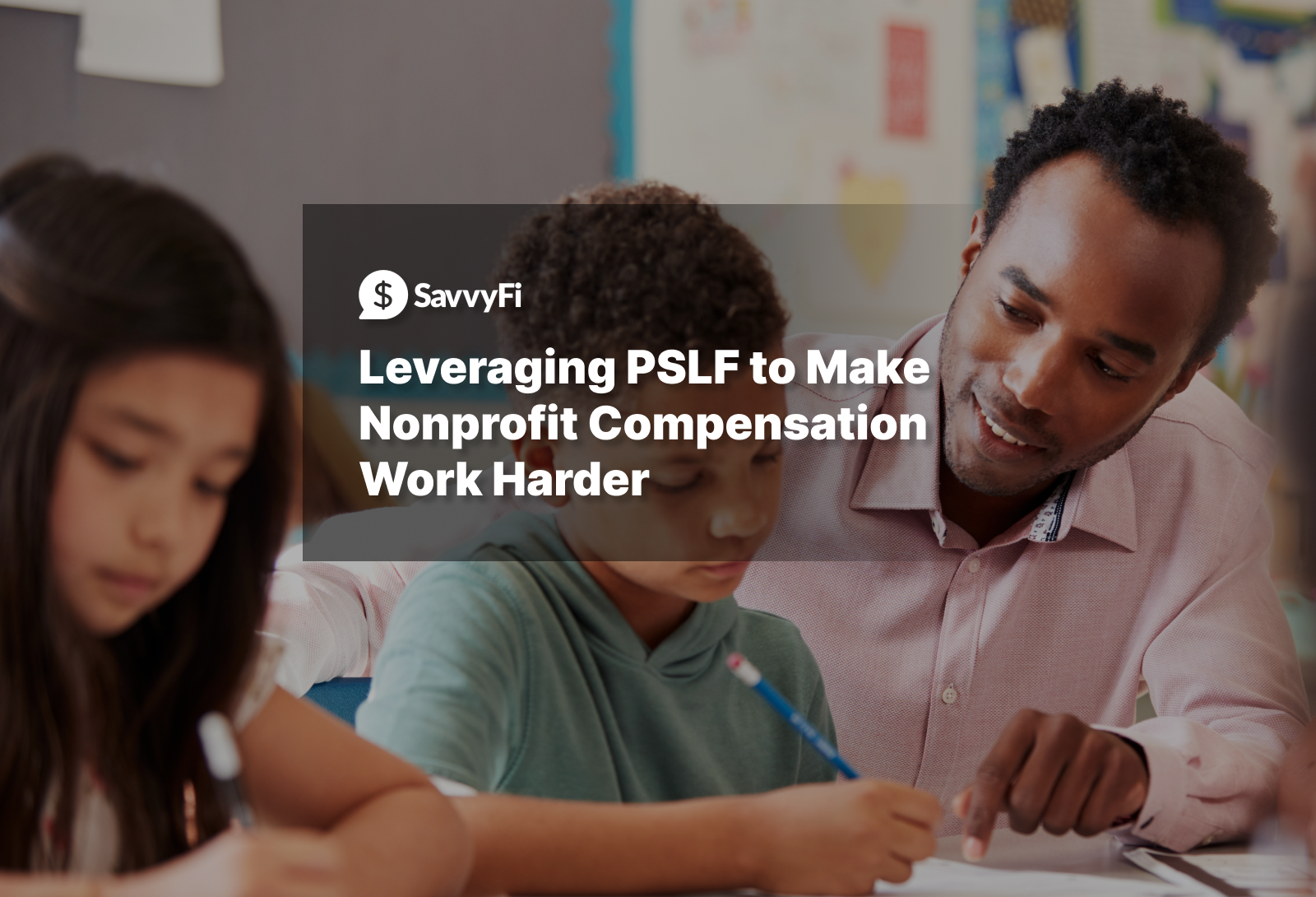
Public Service Loan Forgiveness (PSLF) gives nonprofits a way to boost total compensation without raising salaries. The program can erase tens of thousands (or even hundreds of thousands!) of dollars in student loan debt for employees who qualify. For organizations that rely on college-educated talent, PSLF offers a powerful recruitment and retention tool.
The Department of Education has already forgiven more than $62.5 billion in student loans for over 871,000 borrowers. The average borrower has received about $72,000 in forgiveness. Matching that value through salary increases would require roughly $9,000 per year for each eligible employee, an amount most nonprofits cannot afford.
Why Many Eligible Employees Miss Out
In many organizations, only about 5% of eligible employees take advantage of PSLF. Based on benchmarks, that should be around 20% of any given nonprofits’ headcount. Most run into roadblocks:
- They believe they are not eligible.
- They assume the program will reject them because of its historic 98% rejection rate. (More on this egregious number later in this article!)
- They use the wrong repayment plan, which leads to overpayments or disqualification.
- They refinance federal loans, which removes eligibility.
- They delay action, thinking they have ten years to figure it out.
Even employees who submit Employment Certification Forms often fail to meet all the requirements. Between November 2020 and July 2022, 98.9% of forms confirmed the employer’s eligibility, but only about 2.4% met the full PSLF criteria. The most common disqualifiers include:
- Ineligible loan types, which cause more than 80% of rejections
- Wrong repayment plans that either cost more or fail to qualify for PSLF
- Missing or incorrect employer or date information that stops the forgiveness clock
This gap between “appears eligible” and “actually on track” is where employees lose out. Direct guidance closes that gap.
Options for Employees
Once employees understand the value of PSLF, the next step is figuring out how to navigate the process. They have a few options:
- Work Through the Process Alone
The Department of Education offers a free PSLF Help Tool at studentaid.gov/pslf. This tool guides borrowers through employment certification, repayment plan selection, and application steps. However, the high rejection rate shows that many still run into roadblocks, often because of paperwork errors, loan type issues, or repayment plan mismatches. - Seek One-on-One Guidance
Some borrowers work with independent organizations that specialize in PSLF support. These services can offer personalized help, but quality varies. Employees should research carefully and avoid any company that charges large upfront fees, makes guarantees, or requests sensitive information outside secure channels. - Get Employer-Sponsored Support
The most reliable and cost-effective approach is PSLF assistance offered as an employee benefit. Employers can partner with trusted providers who work directly with staff to ensure every requirement is met. This approach removes guesswork, reduces the risk of disqualification, and shows employees their employer is invested in their long-term financial success. Click here for information about SavvyFi’s PSLF support program.
By making expert guidance available and thus laying out clear paths forward, nonprofits can help more employees move from “eligible” to “approved,” turning PSLF into a tangible part of their total compensation.
How Awareness and Support Improve Results
When employees understand PSLF, choose the right repayment plan, and submit accurate paperwork, they can finally gain access to life-changing financial relief.
Support also builds confidence. Once employees believe PSLF can work for them, they commit to the process and follow it through.
The Retention and Budget Impact
PSLF and other student loan benefits can significantly reduce turnover:
- Some studies show a 26% decrease in turnover for employees who receive student loan benefits.
- In education and healthcare, employees who receive PSLF support often stay the full ten years to qualify for forgiveness.
What does that look like?
For 100 eligible employees with an average of $70k annual salary, let’s assume 20% sign up for your PSLF advisory benefit. If your current turnover is at 30% and the benefit helps reduce turnover by 26%, the annual turnover cost prevented is ~$54,600.
Pairing PSLF with Section 127 for Greater Impact
PSLF works even better alongside Section 127 of the IRS code, which lets employers contribute up to $5,250 per year toward an employee’s student loans, tax-free for both the employer and the employee.
Compared to a raise:
- A $3,000 raise for an employee earning $70,000 costs the employer about $4,200 after payroll taxes, and the employee pays taxes on the raise. The bump might put them in a higher tax bracket as well.
- A $3,000 loan contribution through Section 127 costs exactly $3,000 and the employee receives the full amount tax-free.
When combined with the reduced monthly payments from an income-driven plan under PSLF, this approach can free up hundreds of dollars each month for the employee without increasing taxable wages.
What does that look like?
If PSLF eligibility lowers an employee’s monthly payment by $200, that equals a 3.4% raise on a $70,000 salary. Add a $3,000 Section 127 contribution, and the benefit feels like an even bigger raise (7.7%), while also accelerating loan forgiveness.
Why This Matters for Nonprofits
PSLF helps employees reduce financial stress and stay committed to the mission. It also makes recruiting easier by appealing to candidates who might otherwise choose higher-paying private-sector roles. Most importantly, it accomplishes this without increasing the salary budget.
For nonprofits that need to stretch every dollar, benefits that expand the value of compensation are not extras. They are essential tools for sustaining the mission.
About SavvyFi: SavvyFi is a user-friendly fintech platform that makes it easy for employers to provide college savings and student loan benefits to their employees. Because the company’s platform is “zero-touch” to HR — without any complicated systems, integrations, or paperwork — SavvyFi unlocks education financing capabilities to even the smallest employers that would not otherwise be able to offer these benefits.
Disclosure: Third-party quotes shown may not be representative of the experience of all SavvyFi customers and do not represent a guarantee of future performance or success.